
Study setting, design, and period
Harari regional state is one of the nine regional states found in Ethiopia. Harar city is the capital of the Harari region found 510 km away from Addis Ababa in the eastern part of the country. The Harari region is the smallest regional state in Ethiopia, with nine Woredas and 36 Kebeles, and 59,487 total households. According to the 2016 Harari Regional Health Bureau report, the region has a total population of 240,000, of those 123,072 are females and 53,383 are women of reproductive age group17. There are two public hospitals, one private Hospital, one military Hospital, and eight public health centers with 1191 health professionals in the region. Antenatal care services (ANC) is provided using 2002 WHO focus ANC model by male or female midwives/clinical nurses in all public health facilities in the region. An institution-based cross-sectional study design was employed among pregnant women attending ANC services in selected public health facilities of the Harari region, eastern Ethiopia, from December 15, 2023 to January 15, 2024.
Study population, sample size and procedure
Based on the 2022 national population census projection, the region has estimated total populations of 276,000, of which 137,000 females and 139,000 males, 72,525 households, 8740 were pregnant women, 38,382 under five children and 8181 under one children. All pregnant women aged 18 years and above were included in the study. However, pregnant women with medical complications or contraindications such as pre-eclampsia, severe anemia, cardiovascular diseases, and women with injuries like limited mobility, and severe mental health conditions that could impede physical activity were excluded from the study18,19. The sample size was computed using the Epi-Info version 7.2, considering the assumption for a single population proportion: a 57.9% proportion of physical activity from a previous similar study in Ethiopia, 95% confidence interval, 5% margin of error, and 10% response rate. The stratified random sampling was used to select the study participants. Accordingly, health facilities were stratified as urban and rural, then 50% of the facilities were selected from each stratum using a lottery method. The total calculated sample size was 435 pregnant women. Finally, study units were selected using a systematic random sampling technique after proportional allocation of sample size to each selected health facility and using the client registration book as a sampling frame.
Data collection methods
Data were collected using structured and pretested questionnaires adapted from the standardized pregnancy physical activity questionnaire (PPAQ) through face-to-face interviews and client medical record reviews20. The questionnaires contain socio-demographic characteristics, reproductive and medical factors, knowledge, attitude and perception towards PPA, and physical activity practice during pregnancy. PPAQ contain thirty-one items grouped into four themes: household, occupational, sports/exercise and transportation, and sedentary activities20.
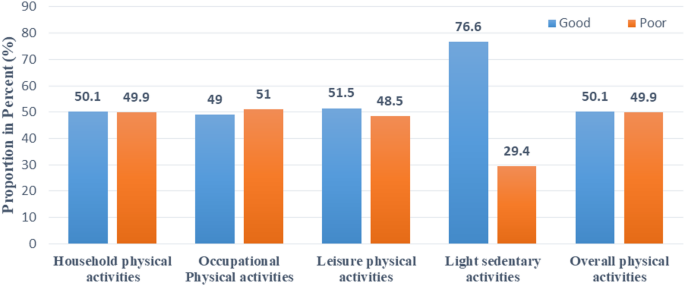
Physical activity was assessed using a 31-item questionnaire that captured the frequency, duration, and intensity of various activities across four domains: household/caregiving, occupational, leisure, and sedentary activities. Pregnant women were asked to estimate the amount of time spent on each activity per day or per week during pregnancy, with duration ranging from zero to seven days per week..
Total physical activity was calculated by summing the product of duration and intensity (in METs) for each reported activity. Activities were classified based on their intensity levels using Metabolic Equivalent of Task (MET) values: sedentary (< 1.5 METs), light (1.6–2.9 METs), moderate (3.0–5.9 METs), and vigorous (≥ 6.0 METs)20.
Total activity was quantified in MET minutes per week and categorized as ‘Good’ or ‘Poor’ based on the median value. Participants with METs scores equal to or above the median (≥ 60.36) were classified as having a ‘good’ level of physical activity21.
Attitude towards pregnant physical activity was measured using 6 items/questions with “yes” and “no” response options. Each response was assigned a score, with higher scores indicating a more positive attitude toward physical activity. A composite index score was calculated by summing the responses across all items. Pregnant women who scored at or above the median of this composite score were classified as having a good attitude22.
The perceived benefit of pregnant physical activity was assessed through 13 items/questions designed to capture the participants’ beliefs about the positive outcomes of physical activity22. Each item used a 5-point Likert scale, with response options ranging from “Strongly agree” to “Strongly disagree,” allowing participants to express the degree of their agreement23. The participant’s response was summed to form a composite score. Accordingly, participants who scored equal to or above the median were categorized as having a good perceived benefit22.
The perceived barrier to physical activity was measured using 8 items/questions that identified participants’ hindered ability to engage in physical activity during pregnancy. Each item was rated on a 5-point Likert scale, with the response range from “strongly agree” to “strongly disagree”. A composite score was calculated by summing the scores of all items, with higher scores indicating a greater perception of barriers toward physical activity. Participants who scored equal to or above the median were categorized as having a good perceived barrier24.
Socio-demographic variables like the study subjects’ age was recorded based on their response, and categorized into 18–24, 25–34, and ≥ 35 years, marital status categorized as married, divorced, and widowed, residence categorized into urban or rural, educational status categorized as no formal education, primary education, secondary education, and diploma and above, occupational status categorized into housewives, employed; governmental or private, unemployed, and merchant, and average monthly income was categorized as ≥ 2800 Ethiopian birr, and < 2800 Ethiopian Birr. Reproductive variables include type of facility where ANC was attended (health center, hospital), pregnancy intention (planned, unplanned), parity (nulliparous, primiparous, multiparous) and abortion history (yes/no). In addition, variables like knowledge, attitude and perception, awareness, perceived benefits and barriers of physical activity were included in the study25,26,27.
Data quality control
The data collection instrument was developed in English, then translated into Afan Oromo and Amharic, and back translated to English to check its consistency. Six midwives with bachelor’s degrees data collectors, and a supervisor (Master of Public Health degree holder), who fluently speak Amharic and Afan Oromo languages were recruited based on their previous experience in data collection.
Training on the data collection process and ethical considerations was given to data collectors, and a pretest was conducted on 5% of the sample size in a separate non-selected facility two weeks before the actual data collection. During this process, inconsistencies in the questionnaire were identified and corrected to minimize potential issues during data collection. The revised questionnaire was then finalized for use in the main study.
The questionnaire was checked for completeness daily during data collection, and errors were corrected on the spot. Routine supervision was carried out daily.
Data processing and analyses
The data was checked for completeness and entered Epi-Data 3.1, and exported to SPSS version 26.0 for analysis. Univariate analysis was employed to describe the outcome and explanatory variables. Multicollinearity was checked using the variance inflation factor (VIF) for independent variables. Bivariate and multivariable binary logistic regression analyses were done to identify factors associated with the practice of physical activity. Independent variables with a P-value < 0.25 in the bivariable analysis were considered for the multivariable analysis model. Adjusted odds ratio (OR) with 95% CI was used to report association, and the significance level was declared at P-value < 0.05.
Ethics approval and consent to participate
The ethical approval was obtained from Haramaya University Institutional Health Research Ethics Review Committee (IHRERC) with reference number (IHRERC/237/2023). All methods were performed in accordance with the relevant guidelines and regulations of the Declaration of Helsinki. Data collectors handled confidentiality and privacy issues using a consent form attached to the questionnaire. Participants’ personal information identifiers, such as names, were not written on the tools during data collection/interview. The study’s purposes, procedures, duration, risks, and benefits were clearly explained to participants before obtaining written informed consent. Informed voluntary written informed consent was obtained from each participant, while those who were not willing to engage in the study at any time were allowed to withdraw.
Consent for publication
Not applicable. This study does not involve the publication of any identifiable patient/participant data or images.
link